
ISO New England is an independent, nonprofit corporation. We are authorized by the Federal Energy Regulatory Commission (FERC) to operate the power system, plan the power system, and develop and administer the wholesale electricity markets for the six-state New England region. Four distinct entities provide oversight of ISO New England. They are:
The ISO also engages two independent market monitors, one internal and one external, to regularly review, analyze, and report on market results, and offer recommendations on market improvements. They are also responsible for notifying FERC of any behavior, by market participants or the ISO, that requires investigation. The market monitors report directly to the ISO’s board of directors.

The ISO New England Inc. Transmission, Markets, and Services Tariff details the rules we follow in administering the wholesale electricity markets and planning and operating the bulk power system, and describes the mechanism for our funding. Absent exigent circumstances, it can only be amended following a robust stakeholder process, described in the next section. Changing the tariff always requires FERC’s approval. FERC has its own regulatory process to evaluate any tariff changes, which includes opportunity for public comment.
Other documents relevant to the ISO’s rules, processes, and relationships with regional stakeholders include our Transmission Operating Agreement with participating transmission owners and our Participants Agreement, which describes the collaborative process between the ISO and market participants. The ISO also has a memorandum of understanding with the New England States Committee on Electricity (NESCOE), described in a later section.
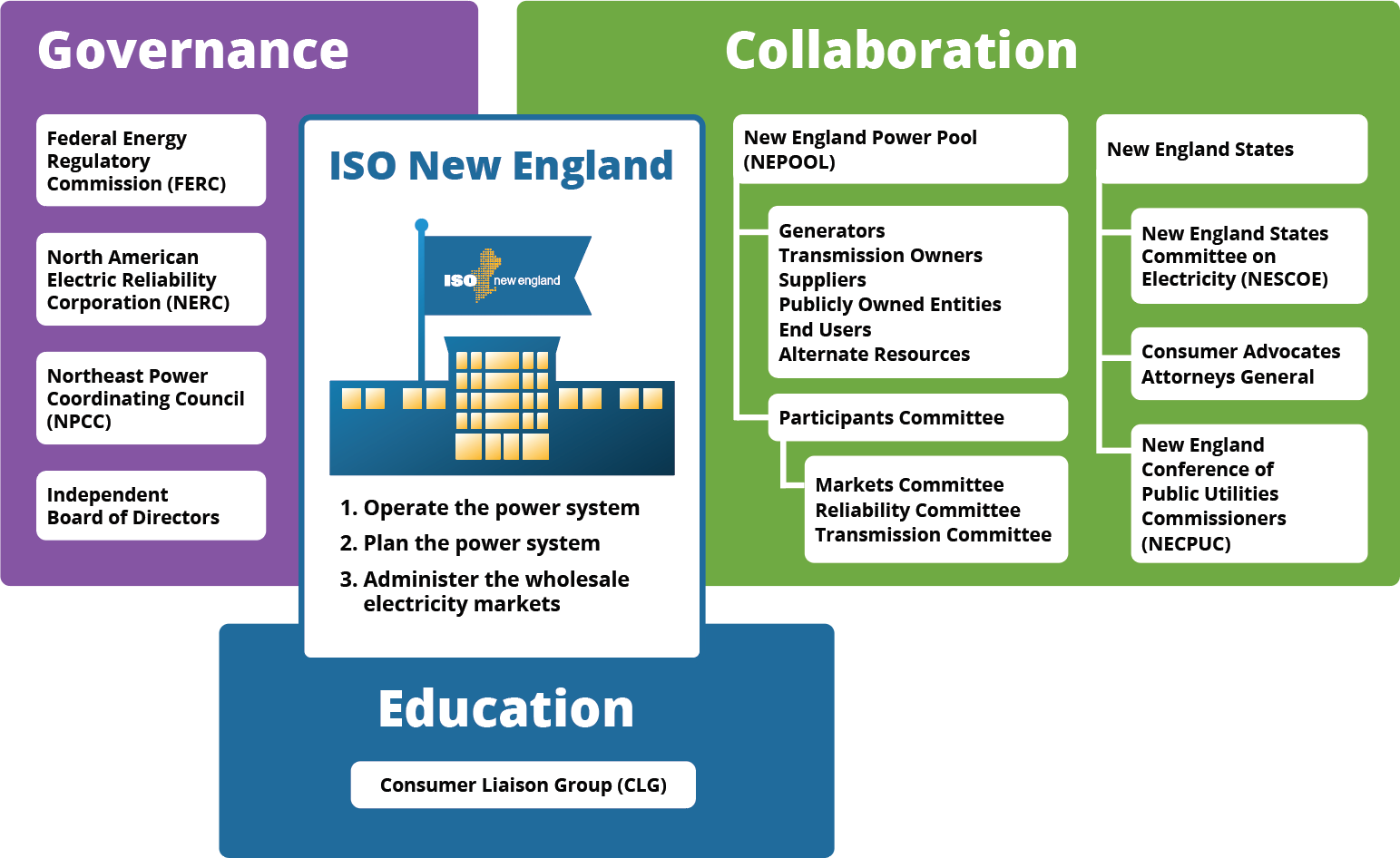

The ISO collaborates with a wide range of stakeholders in the New England region, through various forums and committees, prior to any filing with FERC. These groups include the following:
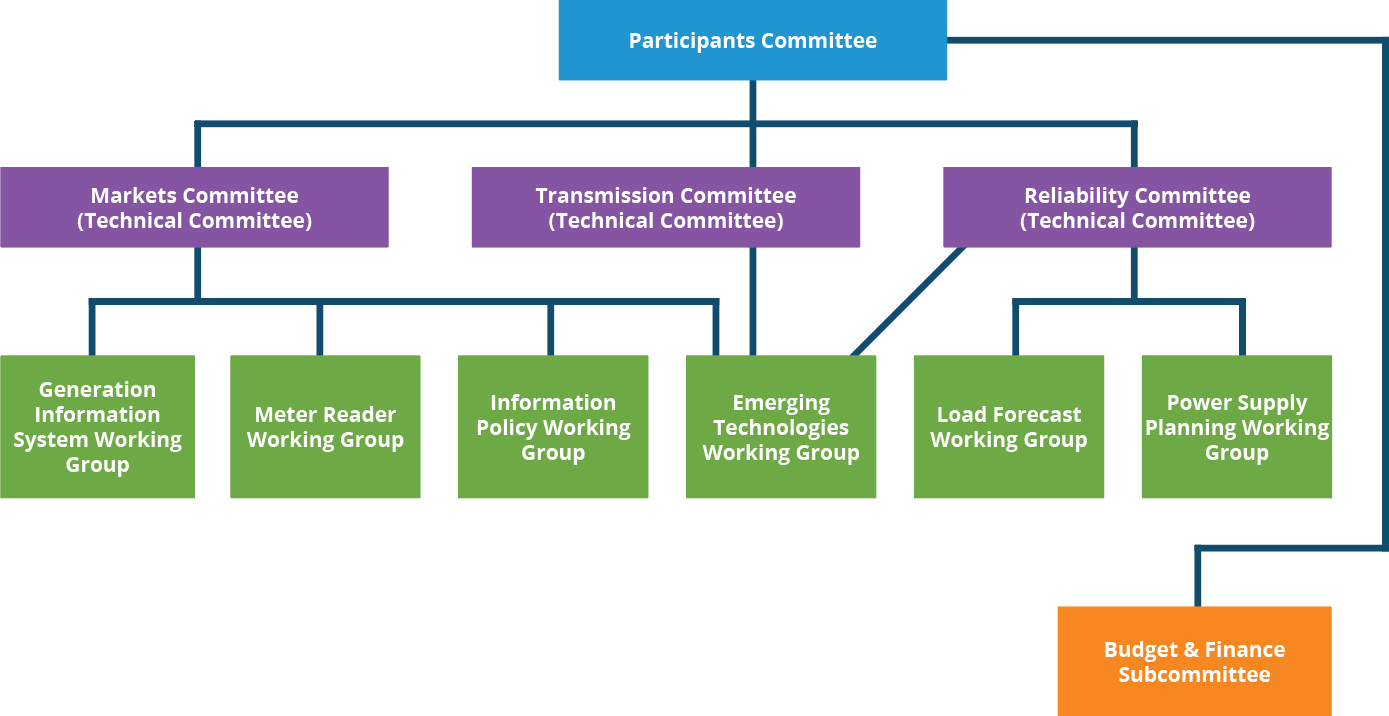
NEPOOL is a voluntary association of representatives from six sectors of the electricity industry: generators, suppliers, transmission owners or utilities, end users, publicly owned entities, and alternative resources. The ISO participates in the NEPOOL stakeholder process, which involves collaboration through the following principal and technical committees:
Each committee also has subcommittees or working groups that meet regularly throughout the year. These meetings allow for discussion and voting on market rule changes, potential transmission upgrades, and other initiatives affecting the regional grid, many of which require a tariff amendment to proceed. Stakeholders and the ISO solicit and share information, which helps ensure that proposals are thoroughly considered, reflect a wide range of perspectives, and advance through formal voting steps that guide how regional energy policies and rules are shaped. This work supports well-informed decisions that contribute to reliable operations and effective market design for the region.
After a vote in the technical committees, proposals move to the Participants Committee for a final vote. NEPOOL members can also offer amendments to proposals at the relevant committee.
Generally speaking, after the stakeholder process, the ISO is free to make any necessary filing with FERC. But if NEPOOL stakeholders support a different market-related proposal, and that proposal achieves a supermajority vote at the Participants Committee, the ISO is required to file the alternative with FERC at the same time, allowing FERC to approve either one. This is known as NEPOOL’s “jump ball” right.
NESCOE represents the policy perspectives of the governors of the six New England states on matters of resource adequacy and system planning and expansion. It has a memo of understanding with the ISO and NEPOOL that is grounded in collaboration and consultation. NESCOE often presents policy-related matters at NEPOOL committee meetings, though NESCOE, by choice, is not a voting member of NEPOOL. NESCOE is funded through a schedule in the ISO’s budget. NESCOE is the FERC-approved Regional State Committee for New England.
NECPUC is a regional organization representing the six New England state utility commissions. NECPUC representatives are actively engaged in NEPOOL and ISO-led stakeholder processes; however, they participate, by choice, as nonvoting members.
The Planning Advisory Committee is a nonvoting body composed of stakeholders and ISO-NE staff that serves as a venue to discuss planning for the future of the regional transmission system.
Members of the public are represented at NEPOOL committee meetings by government-appointed consumer advocates. Electricity consumers may also be represented by individual and business ratepayer groups, environmental nonprofits, and other collectives that are actively engaged in the NEPOOL stakeholder process. All of these groups have chosen to become voting members of NEPOOL in the end user sector.
The public can engage with the ISO directly by attending meetings of the Consumer Liaison Group, a nonvoting, open educational forum run by the ISO that meets four times a year. Members of the public can submit comments to the ISO’s board of directors through the board’s webpage, and can also participate in the board’s annual open meeting. Additional information is also available on the ISO’s Consumer Resources webpage.
Every employee, officer, and board member of ISO New England must sign and follow the Code of Conduct, which ensures we have no financial or other interest in any of the companies that participate in the wholesale electricity markets or own the transmission and distribution systems. FERC also maintains rules requiring our independence.
Our governing structure and our independence allow us to deliver reliable electricity at competitive prices — today and for future generations.
Learn more about the ISO’s critical roles, mission and vision in What We Do, Who We Are, and Where We’re Going, more about the establishment of our role in Our History, and more about consumer engagement in Public Affairs.