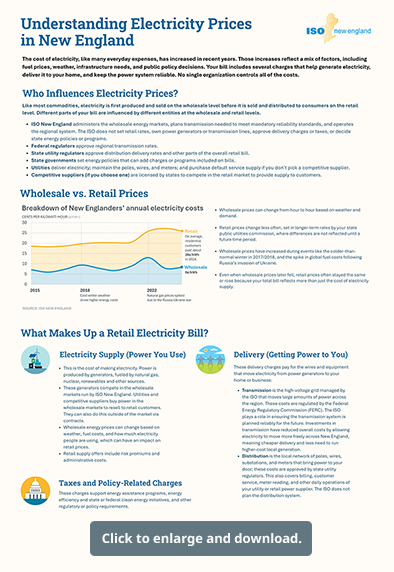
ISO New England is the nonprofit that runs the power grid for Connecticut, Massachusetts, New Hampshire, Rhode Island, Vermont, and most of Maine. One of the ISO’s key roles is overseeing the region’s competitive wholesale electricity markets.
The wholesale markets are where generators and other resources compete to sell electrical energy and related services. Utilities and other organizations buy that electricity and distribute it at the retail level — that is, to homes and businesses.
Costs associated with the wholesale markets ISO New England administers, as well as the transmission system, make up about a third of the average residential customer’s annual electricity costs. The remaining two-thirds of the average electric bill is related to the retail system and state policies, and is outside of the ISO’s control. Retail electricity rates are approved by state utility regulators.
The following are frequently asked questions about retail and wholesale electricity costs.
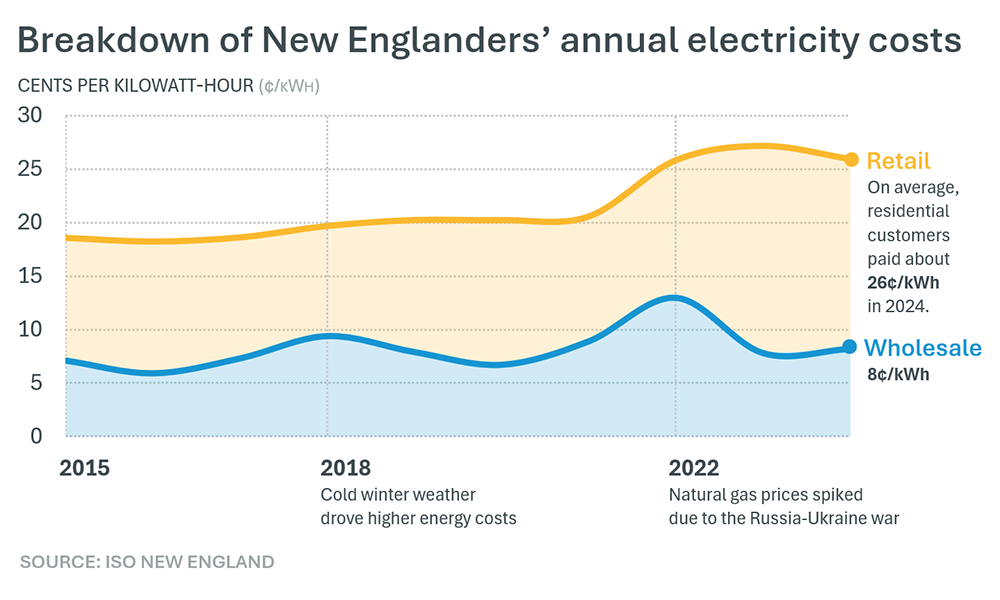
Like other commodities, electricity is first produced and sold at the wholesale level. From there, it’s distributed to consumers at the retail level.
Wholesale electricity is bought and sold in two ways:
Prices in the wholesale markets primarily reflect shorter-term electricity production costs, while retail rates reflect longer-term, fixed-price contracts. Retail rates vary from state to state and utility to utility depending on procurement practices. Retail rates are approved by state public utility commissions based on each state’s policy and market structure. ISO New England has no control over retail rates.
To an extent, longer-term retail rates shield consumers from any volatility in shorter-term wholesale prices. But sustained high prices in the wholesale markets may translate at a later time to higher costs for utilities.
Over the last 10 years, wholesale prices have increased in response to heightened demand during the colder-than-usual winter of 2017/2018 and supply chain constraints resulting from Russia’s invasion of Ukraine in 2022. Wholesale costs subsequently decreased after these events. Retail costs have tended to stay the same or go up in the region due to other factors.
Wholesale electricity costs affect two parts of monthly electricity bills:
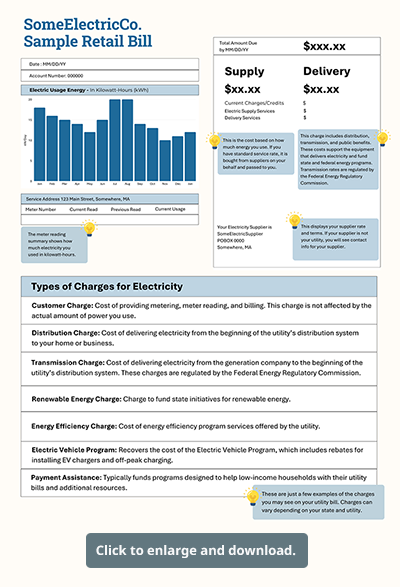
There are several items on your monthly electric bill that ISO New England does not have a role in. These include:
Wholesale costs, generally indicated as “supply” on your bill, reflect payments to the resources that meet New Englanders’ demand for electricity, as well as investments in the regional transmission system. They also include the cost of all ISO New England functions, referred to as regional transmission organization (RTO) costs.
The largest component of wholesale costs is energy production. Energy prices change continuously depending on fuel costs, consumer demand, transmission constraints, and other factors.
Reliability services are payments to generators and others that are outside of energy production but instead are designed to ensure the region has adequate energy available. The two major categories are:
More information about reliability services is available on the ISO’s market administration page.
The region’s wholesale electricity markets are designed to select the lowest-priced resources necessary to meet the region’s demand for electricity. In addition, an Internal Market Monitor provides in-depth analysis and oversees participant behavior to ensure fair competition and adherence to market rules.
ISO New England guides investment in the regional transmission system to address reliability needs. These investments have nearly eliminated costs related to congestion, where there is adequate energy produced but a lack of transmission infrastructure to move it where it needs to go. Congestion drives significant extra costs in other regions. In addition, the regional system planning process implemented by the ISO requires selection of the most cost-effective projects to address the identified reliability issues and the appropriate allocation of costs.
ISO New England is in the process of taking on the role of asset condition reviewer, a step intended to increase transparency around transmission owners’ proposals to replace deteriorating equipment and facilities.
As a nonprofit, the ISO is funded via fees on transactions in the wholesale markets and for transmission-related services. ISO New England is the only regional transmission organization in the United States that submits its annual budget to the states and the Federal Energy Regulatory Commission for approval.